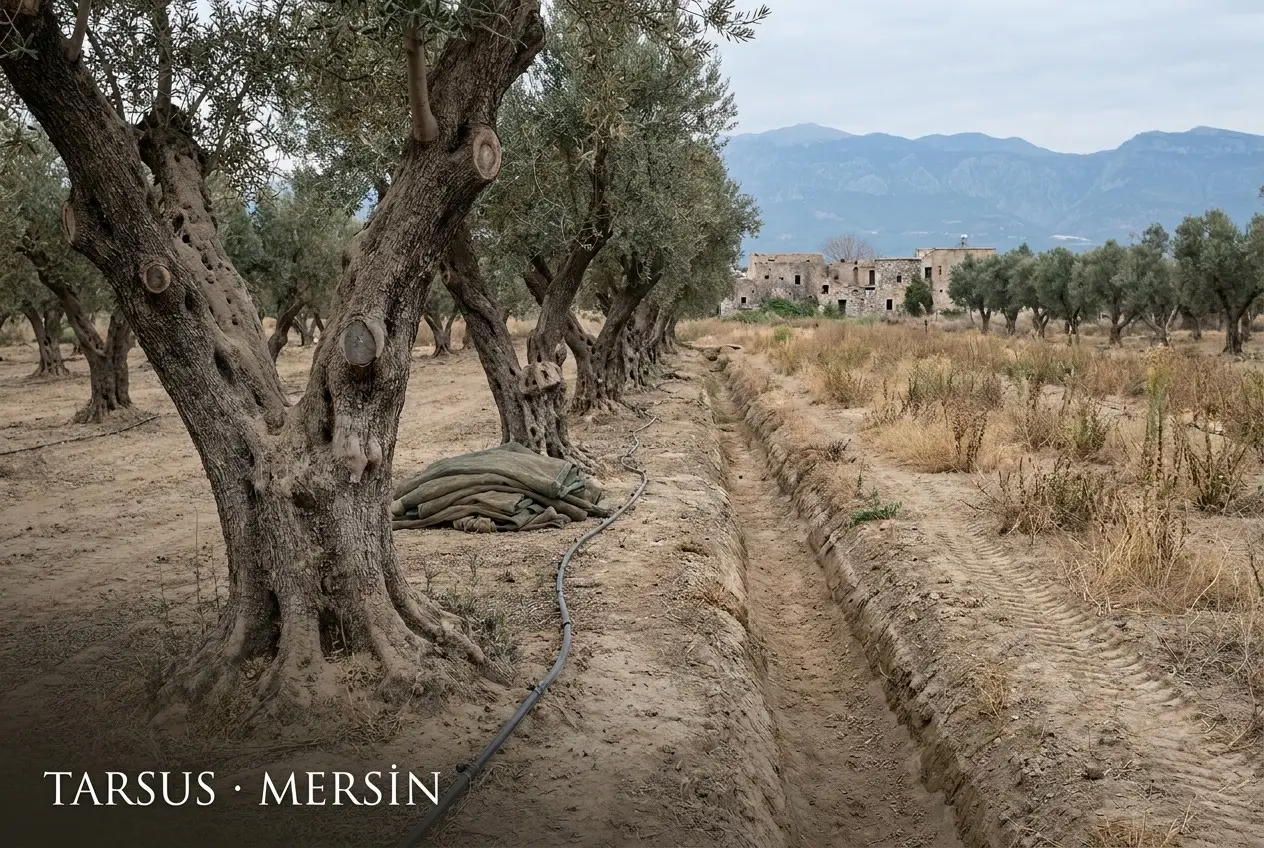
Tarsus — Homeland of Sarıulak
Tarsus is where the Sarıulak olive comes from, and it holds two separate protected designations — one for the olive, one for the oil.
Tarsus is one of the most strongly registered olive districts on the Turkish Mediterranean, and the reason rests on a single variety: Sarıulak. Across the Çukurova basin and the foothills rising toward the Taurus Mountains, the regional climate shapes an olive trade that balances two distinct culinary uses. In this landscape, genuine Mersin zeytinyağı and distinct Tarsus zeytinyağı occupy a clearly documented place defined by official registration rather than generalized regional claims.
Two separate geographical indications
The Turkish Patent and Trademark Office has registered two independent protected designations of origin for Tarsus:
- Tarsus Sarıulak Olive — designation of origin, no. 345, 16 April 2018
- Tarsus Sarıulak Olive Oil — designation of origin, no. 767, 25 May 2021
Both registrations are bounded to the district of Tarsus alone. The specification defines the product precisely: oleic acid 65.6–70.1%, oil content in the fruit 18.7–19.6%, total phenols 602–836 ppm, and a requirement for early harvest.
The distinction matters. A designation of origin is the stricter form of geographical indication: an official acknowledgement that a product's character belongs to that locality and cannot be reproduced the same way elsewhere. Registering the fruit and the oil separately shows that both table and oil production are taken seriously here in their own right. Early picking protects the natural antioxidants before the fruit softens under the southern sun, while cold extraction keeps the delicate aromatic compounds intact during the milling process.
How many trees stand in Tarsus?
In the words of the registration document itself: of the 1.7 million olive trees in Tarsus, about 25% are the Tarsus Sarıulak variety. By planted area the widest is Gemlik (2,960 hectares), followed by Sarıulak (431 ha), Ayvalık (307 ha) and Topakulak (226 ha). The district also has organic olive production: 139 growers across 228 hectares.
This variety distribution illustrates the commercial reality of the district. While modern plantings of other cultivars have expanded for commercial table output, the native groves maintain their historic role in high-phenolic extraction. For growers, maintaining these parcels demands careful orchard management, because fruit harvested at higher temperatures must reach processing without delay to prevent enzymatic degradation and keep free acidity within tight parameters.
Why Sarıulak matters
Sarıulak is one of the eastern Mediterranean's most widespread varieties, grown across Mersin's central districts and in Erdemli, Gülnar and Tarsus, as well as Adana's Seyhan, Kozan and Yumurtalık. The fruit is medium-large with a notably big stone and an oil content around 18–19%. Being usable for both table and oil gives the grower a choice at harvest.
The dual-purpose nature of the crop creates a practical rhythm during the picking period. When the skin begins its color transition, hand-picked batches are directed toward table preparations, while lots intended for pressing go directly to milling. The relatively large pit-to-flesh ratio presents a mechanical reality in the press, yet the resulting liquid carries the distinctive regional profile documented in the official origin gazette.
What we source here
From Tarsus we buy both table olives for brining and oil fruit. On the oil side, grading is done by analysis as always: extra virgin, virgin, and where appropriate refined and olive oil (riviera).
When purchasing from local producers, our process begins with direct sampling. Free acidity is measured on site using our internal laboratory facilities in Düziçi; this testing serves purely for informational classification and pricing between trading parties rather than as an accredited legal certification. For lots meeting our requirements, we conduct weighing and settle payment directly on location. Fruit selected for table lots enters natural brine processing as salamuralık sofralık zeytin, while pressings are segregated strictly by measured serbest asitlik levels into natürel sızma zeytinyağı, natürel birinci zeytinyağı, or raw material for rafine zeytinyağı and blended riviera zeytinyağı.
Working with a registered variety comes with a responsibility we take seriously: the name "Tarsus Sarıulak" is used only for produce genuinely within that registration. Our trade is naming grade and origin honestly; using a protected name outside its scope would be wrong both in law and toward the customer.
Retail, wholesale, delivery
For households, 1-litre glass bottles and 5-litre tins; for hotels, restaurants and catering, 16 kg tins and bulk up to 25 tonnes. Leave an online order request and our team will call with current pricing and payment options (bank transfer or credit card). We invoice a company or an individual and ship to all 81 provinces.
Our logistics network serves both individual domestic kitchens seeking perakende zeytinyağı and commercial kitchens, grocery stores, and hospitality venues requiring steady toptan zeytinyağı supply. Every consignment leaves our facility under controlled storage practices, protected from direct sunlight, air contact, and extreme heat. Whether managing single-parcel dispatches by reliable cargo carriers for home consumers or arranging road tankers for industrial bulk buyers and export partners, we provide clear corporate invoicing and traceable dispatch across the entire national distribution chain.