Osmaniye Centre — Heart of the Registered Name
Osmaniye's central district holds a third of the province's olive area and every one of its brining plants. The registered name "Osmaniye Zeytinyağı" carries this province's name.
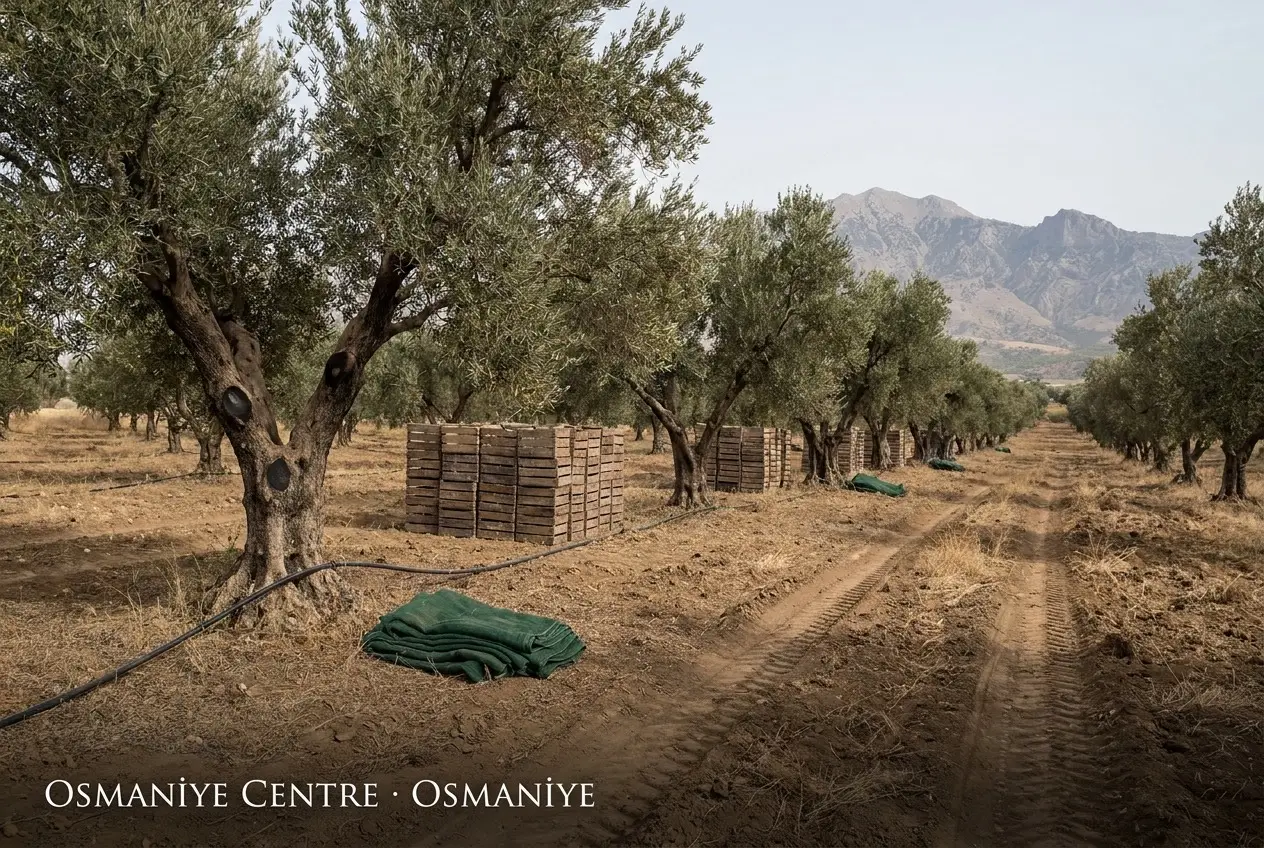
Osmaniye's central district is the province's olive centre of gravity: 4,383 hectares of groves, 1.49 million trees and 18,570 tonnes of production — roughly a third of the provincial olive area. Olive accounts for 84% of the district's fruit-growing land. The agricultural landscape around the provincial seat has long been organized around the seasonal rhythm of the olive tree, combining centuries-old grove management with modern processing capacity that serves both domestic kitchens and commercial food businesses.
The concentration of olive groves across the central basin shapes the regional trade in multiple ways. On one side stands oil extraction, anchored by varieties adapted to the Mediterranean climate; on the other lies table olive processing, sustained by dedicated post-harvest infrastructure. Whether supplying fresh fruit for early milling or handling large harvests for industrial bottling, Osmaniye Centre zeytinyağı operations set the commercial pace for the surrounding agricultural economy.
Osmaniye Zeytinyağı: a registered name
This province's olive oil is registered with the Turkish Patent and Trademark Office as a geographical indication: "Osmaniye Zeytinyağı", registration no. 1317, 11 January 2023. It was registered by the Osmaniye Chamber of Commerce and Industry, and the protected boundary is the entire province — Düziçi, Kadirli, Toprakkale and the centre all fall within it.
The specification defines the product seriously. The oil must be extra virgin and the fruit pressed within 48 hours of harvest. This strict timeline is not arbitrary: once olives are separated from the branch, enzymatic breakdown and oxidation begin immediately. Prolonged storage in sacks or open piles causes cellular degradation, rapidly increasing free acidity and introducing sensory defects. Pressing within two days ensures that natural aromatic compounds and antioxidants remain intact.
Sensory thresholds are written into the registration: fruitiness at least 6.4, bitterness at least 6.0, pungency at least 6.1. Total phenolics sit around 530 mg/kg, and oleic acid near 74%. The varieties named are Gemlik and Ayvalık. High oleic acid values provide thermal and oxidative stability, while robust phenolic levels deliver the characteristic peppery finish on the throat and pleasant bitterness on the palate. If you are wondering what those numbers mean, see our guide to analysis values — bitterness and pungency are not faults but signs of fresh, polyphenol-rich oil produced under careful cold press conditions.
Where table olives are cured
Every one of the province's fermentation and brining plants sits in the central district, which makes it decisive for our supply of table olives for brining. It is a different trade from oil: variety, fruit size and picking method are all chosen separately. While oil production prioritizes oil yield and phenolic balance, table fruit—specifically salamuralık zeytin and general sofralık zeytin selections—demands unblemished skin, firm flesh-to-pit ratios, and uniform calibration.
Harvesting for table curing requires hand-picking or careful mechanical shaking onto soft nets to prevent bruising. Once collected, the fruit moves directly into the district's brining facilities, where natural debittering and fermentation proceed under controlled salt concentrations. This central concentration of curing infrastructure allows us to source properly graded table olives alongside our primary olive oil operations, maintaining consistent moisture, texture, and taste profiles across batches.
Which year do the numbers belong to?
An honest caution: Osmaniye's olive figures vary from source to source. The most recent official district-level dataset dates from 2014, which is where the district numbers above come from. For the province as a whole, the current official source gives 16,609 hectares for 2024, with 26 oil mills and 21 brining plants. Larger figures circulating in the press have no traceable source, so we do not use them.
Agricultural transparency requires relying strictly on verifiable public records rather than speculative estimates. Tree plantings and grove rejuvenations have continued across the central plain, but until official district-by-district agricultural censuses are updated, we ground our regional assessments in documented baselines. This disciplined approach extends to how we evaluate raw harvest yields, pressing ratios, and commercial volume projections throughout the harvesting calendar.
Buying, selling and shipping
What we buy from growers here is analysed and graded at our Düziçi trading centre: extra virgin, virgin, refined, olive oil (riviera). When local farmers bring their crop to our intake points, we conduct free sample testing for serbest asitlik (free acidity) in our internal laboratory. This testing provides immediate operational grading to determine whether lots qualify as natürel sızma zeytinyağı, natürel birinci zeytinyağı, or raw material for refining into rafine zeytinyağı and riviera zeytinyağı blends. Our laboratory measurements serve commercial categorization and quality guidance, functioning as informational checks rather than official accredited certificates. After testing, we provide transparent on-site price quotes, clear weighing on certified scales, and prompt payment directly to the producer.
Our packaging formats are structured to accommodate every scale of consumer and commercial demand. For perakende zeytinyağı (retail) and evsel tüketim (household consumption), we bottle in 1-litre dark glass bottles designed to shield the oil from photo-oxidation, as well as practical 5-litre protective tins. For commercial kitchens, including otel ve restoran (HORECA) clients and catering establishments, we supply durable 16 kg tins that offer practical kitchen handling and reliable barrier protection. For wholesale partners, industrial food producers, packaging facilities, and export operations requiring toptan zeytinyağı, we provide bulk shipments up to 25 tonnes in dedicated road tankers or food-grade flexitanks.
Accessing our regional olive products is straightforward. Prospective buyers can submit their requirements through our online sipariş system. Leave a request — pricing and payment options (bank transfer or credit card) come by phone, we invoice a company or an individual, and we ship nationwide. All orders are packed securely and dispatched via contracted cargo networks and freight carriers to all 81 provinces of Turkey, ensuring that Osmaniye zeytinyağı reaches your door with its chemical purity and sensory profile fully intact.