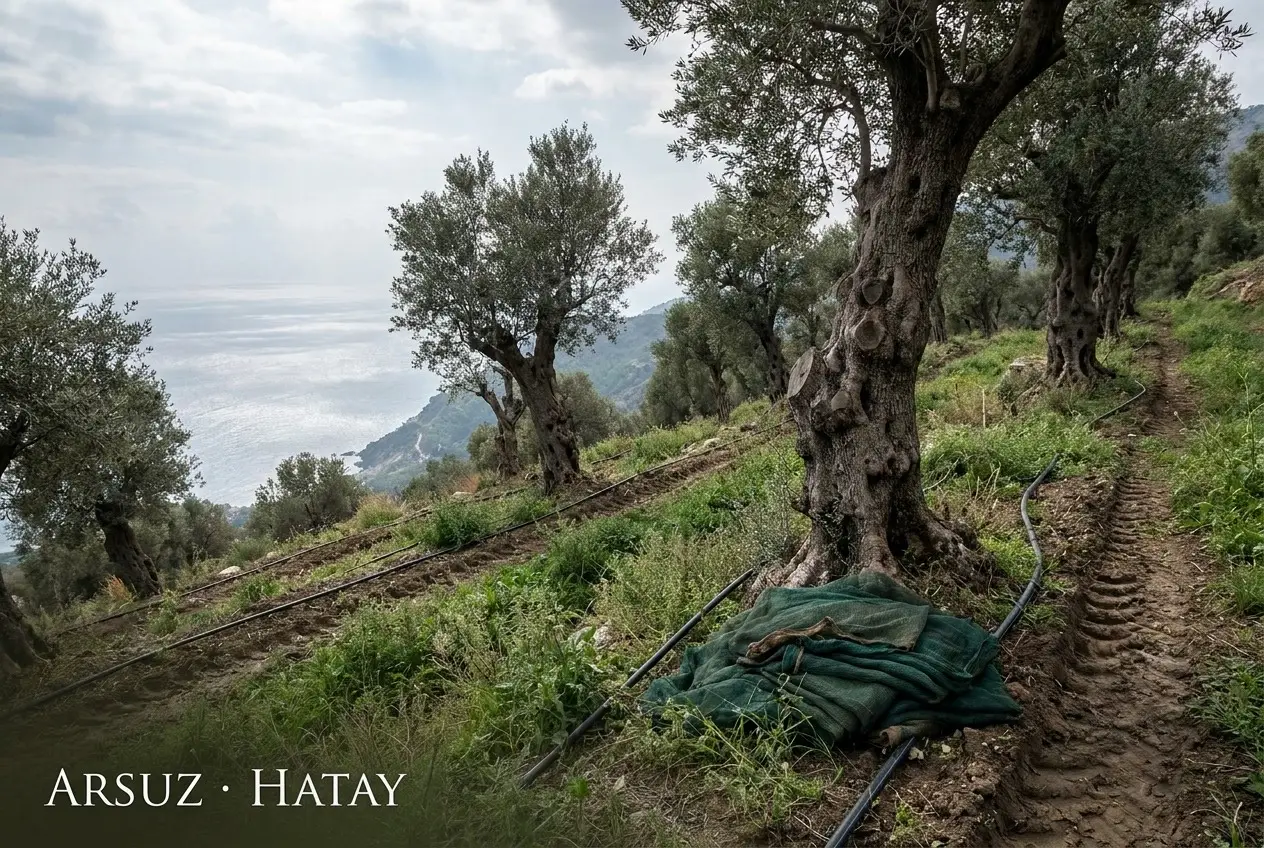
Arsuz — The Province's Most Productive Groves
Arsuz returns the highest yield per hectare in Hatay. From the sea-facing side of the Amanos we source aromatic olive oil suited to retail and household use.
Arsuz returns the highest yield per unit of land of any olive district in Hatay. Its 3,218 hectares carry more than a million trees and produce 25,134 tonnes a year — roughly 7.8 tonnes per hectare, a rate no other district in the province exceeds. This high output is not accidental; it is the direct outcome of fertile coastal soils, accessible ground moisture, and a microclimate shaped by the immediate proximity of the Mediterranean.
In many Mediterranean groves, trees struggle with water stress during the prolonged summer drought, which limits fruit size and overall volume. In Arsuz, the coastal water table and regular maritime humidity soften this seasonal hardship. The trees maintain vegetative growth deeper into the late summer, allowing the drupes to develop uniformly. When harvest arrives in autumn, the yield per tree remains consistently dense, making the district a vital pillar for regional agricultural output and commercial Hatay zeytinyağı production.
Slopes that face the sea
Arsuz lies on the seaward face of the Amanos Mountains — an unusual position for olive cultivation in southern Anatolia. Most regional groves are tucked into interior valleys or high plateaus shielded from the direct marine front. Here, the groves look straight out over the water. By day, humid sea breezes drift up the foothills, moderating ambient heat and slowing down leaf transpiration. By night, cool air masses slide down from the peaks of the Amanos range, creating a substantial day–night temperature gap.
This diurnal temperature swing directly governs the synthesis of secondary metabolites inside the fruit. When daytime warmth is tempered by nighttime cooling, the olive synthesizes higher levels of aromatic esters and polyphenols without degrading its cellular structure. The resulting Arsuz zeytinyağı carries distinct fresh-cut grass, green almond, and mild herbal notes that differentiate it from the heavier, earthy profiles found further inland.
One thing should be said plainly: Arsuz's farming identity is not olive alone. Vegetables, parsley, tropical fruit and citrus are all strong here. Farmland along the shoreline is intensely contested, and groves frequently share borders with intensive greenhouse horticulture and citrus orchards. This polyculture demands high discipline from growers: olive groves must justify their footprint through rigorous management, pruning, and timely picking. The olive area and its yield are real — this is not a place where olive merely happens to grow.
Cold extraction and acidity control
Harvesting along the Arsuz coastal strip begins early in the season. For premium early harvest (erken hasat) batches, fruit is gathered by hand or mechanical shakers while still predominantly green. Ripening happens rapidly in this maritime climate; delaying harvest by even two weeks shifts the fruit from firm green to soft purple, altering the lipid balance. Once picked, olives must be transported to the mill without resting in deep sacks where heat and pressure trigger anaerobic fermentation. Any cellular rupture in the fruit initiates lipolysis, where enzymes break down triglycerides and drive up free acidity (serbest asitlik).
To preserve the delicate volatile compounds generated by the mountain-sea climate, extraction is carried out via mechanical cold press (soğuk sıkım) methods, keeping processing temperatures strictly below 27°C. Maintaining low temperatures during malaxation prevents the evaporation of light aromatic fractions and protects natural antioxidants. Every batch we handle undergoes free acidity testing in our own laboratory facility in Düziçi. This testing categorizes the oil accurately across commercial grades, though it serves purely for operational grading and informational guidance rather than replacing official accredited certification.
What we source here
Arsuz's aromatic profile steers this produce toward retail and household use. Oil from fruit ripened under sea influence suits the table directly — over salad, at breakfast, as a finishing drizzle. Depending on the harvest stage and laboratory evaluation, our sourcing in Arsuz covers the following distinct categories:
- Natürel Sızma Zeytinyağı (Extra Virgin Olive Oil): Sourced from carefully timed early harvest fruit, exhibiting low free acidity and pronounced aromatic freshness for cold applications.
- Natürel Birinci Zeytinyağı (Virgin Olive Oil): A balanced oil with slightly softer fruitiness, ideal for traditional warm cooking and daily kitchen preparations.
- Rafine Zeytinyağı and Riviera Zeytinyağı: Standardized, thermally stable grades suitable for high-heat frying, commercial food manufacturing, and institutional catering.
- Salamuralık Sofralık Zeytin (Table Olives in Brine): Hand-sorted, plump table olives cured naturally in brine to retain a firm bite and balanced natural bitterness.
Batches from here are mostly packed in 1-litre glass bottles and 5-litre tins for household consumption (evsel tüketim). For commercial kitchens, hotels, restaurants, and catering operations (HORECA) looking for bulk olive oil (toptan zeytinyağı), we also supply 16 kg tins and industrial bulk containers up to 25 tonnes for domestic distribution and export. See the complete selection and packaging formats on our products page.
Online ordering and delivery
For retail and wholesale buyers alike, the process is streamlined: select your preferred items, submit your requirements via our online order form, and our sales team will contact you by telephone with current batch pricing and logistic schedules. We accept payments via direct bank transfer (EFT/havale) or major credit cards. Every transaction is documented with a compliant corporate or individual tax invoice.
Once orders are confirmed and prepared, shipments are dispatched via contracted freight and courier services. We provide reliable cargo delivery across all 81 provinces of Türkiye, ensuring sealed containers and palletized shipments arrive safely at residential addresses, retail store shelves, or commercial warehouse facilities.
Get in touch
Do you farm olives in Arsuz? We maintain active purchasing relationships with regional growers throughout the harvest period. See our buying page for details on our transparent procurement process, which includes on-site weight measurement, immediate commercial offers, and prompt settlement. Pre-harvest and post-harvest sample analysis at our lab is completely free of charge for local producers.