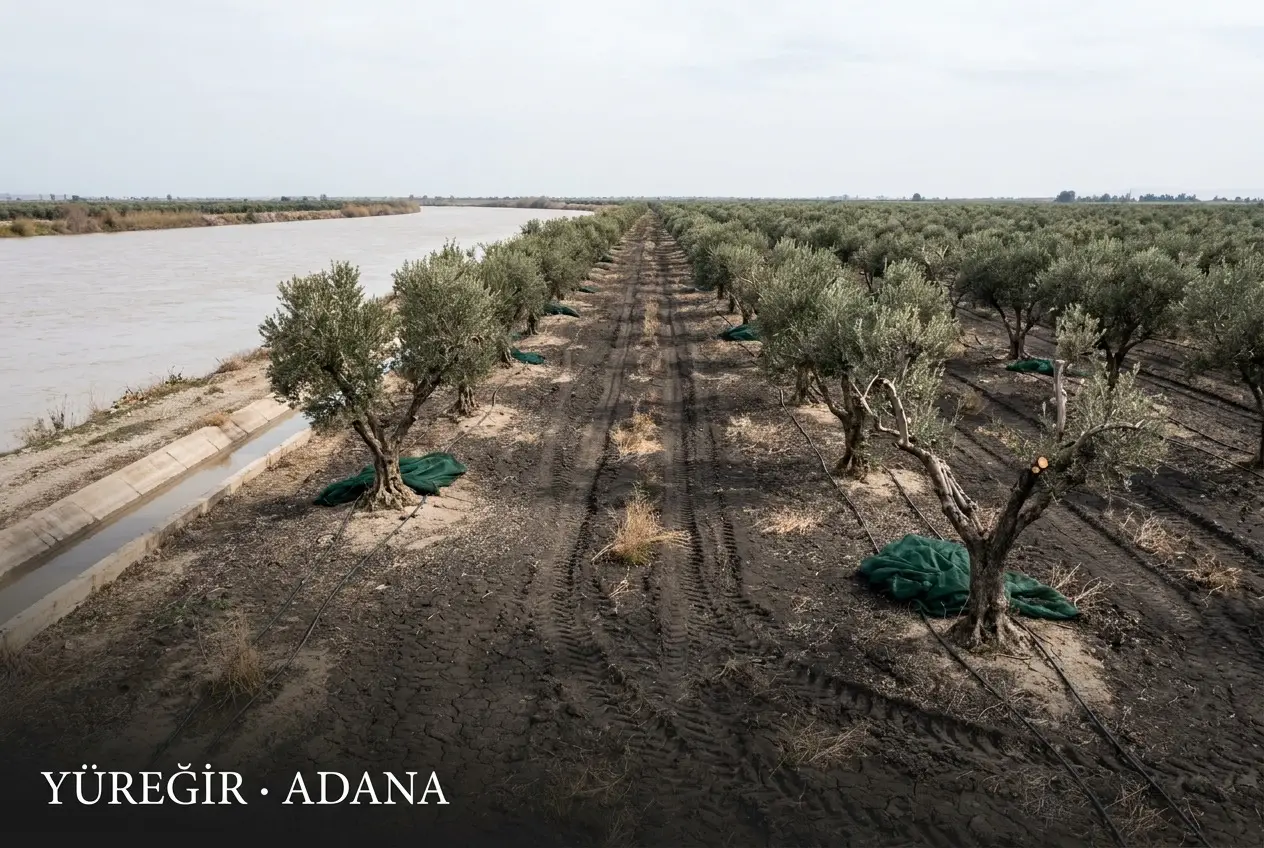
Yüreğir — In the Heart of the Çukurova
Yüreğir is one of Adana's official olive observation districts in national crop estimates, set on the alluvial Çukurova plain.
Yüreğir is Adana's large district east of the Seyhan river, sitting squarely on the alluvial Çukurova plain. In this landscape, olive cultivation takes on a very specific character shaped entirely by flat terrain, deep soils, and subtropical summer heat. The agricultural dynamics here differ fundamentally from the terraced mountain groves of the Mediterranean interior, offering clear operational advantages alongside distinct agronomic challenges for olive oil production.
An official observation district
In the fieldwork the National Olive and Olive Oil Council carries out to set each season's crop estimate, Adana's olive observation districts are listed as Yüreğir, İmamoğlu, Ceyhan and Karaisalı. Yüreğir is a fixture on that list. Being part of this official monitoring grid highlights the district's recognized role in regional production volumes, serving as a key reference point for assessing yield patterns, canopy development, and harvest progression across the southern agricultural corridor.
For regional trade, following Yüreğir gives an early snapshot of the broader Mediterranean harvest. Because the low elevation and warm climate accelerate the growing cycle, fruit development here often outpaces higher inland zones, providing market observers and processors with early indications regarding fruit health, pest pressure, and initial oil yields.
What plain-country olive growing means
The Çukurova is among Türkiye's most fertile plains. Deep alluvial soil, irrigation infrastructure and flat ground add up to high yields and easy mechanised care. Where a tractor cannot reach on a hillside, it moves freely here; harvest, pruning and spraying all cost less. Cultivating olives on level ground enables systematic tractor access, automated shaking, and rapid field collection. This mechanical efficiency significantly shortens the time required to gather fruit across large parcels, reducing labor overhead compared to steep terraces.
In return, plain growing has its own difficulties: where the water table is high, roots can be starved of air, and on a hot plain fruit ripens earlier. Early ripening is not a fault, but it makes timely harvest essential — a late pick pushes free acidity up. High soil moisture requires careful drainage management to prevent root asphyxiation and fungal vulnerability. Furthermore, the intense heat of the plain causes fruit to mature rapidly in early autumn. When olives ripen quickly under high ambient temperatures, cellular respiration accelerates. If harvested fruit sits in bins under the sun rather than moving straight to cold extraction, enzymatic breakdown starts immediately, causing serbest asitlik levels to climb.
To preserve fresh aromatic compounds and keep natural acidity low, early harvesting (erken hasat) and immediate cold pressing (soğuk sıkım) are critical in Yüreğir. Cold extraction ensures that the mechanical processing temperature does not compromise delicate phenolic components or impart thermal defects. For extra virgin grades (natürel sızma zeytinyağı), processing must take place within hours of detachment from the branch.
Varieties
The dominant varieties on the Adana side are Gemlik, Sarıulak and Nizip. The great majority of groves planted in recent years are Gemlik — a well-known variety usable for both table and oil. Gemlik has adapted widely due to its regular bearing habits, high oil content, and dual-purpose utility as both black table olives (sofralık zeytin / salamuralık zeytin) and olive oil. Sarıulak, an indigenous southern cultivar, contributes robust local resilience and distinct aromatic character, while Nizip selections bring balanced oil profiles suited for blending and everyday consumption.
When handled through an early harvest regimen, these varieties yield aromatic natürel sızma zeytinyağı with fresh herbal notes and pleasant bitterness. Parcels picked later in the season or destined for table preparation transition naturally into softer natürel birinci zeytinyağı profiles, or provide the base material for rafine zeytinyağı and balanced riviera zeytinyağı formulations.
The Adana scale
The province holds more than 3.2 million bearing olive trees and about 259,000 not yet bearing. Annual production is 36,800 tonnes of olives — 12,600 for the table, 24,300 for oil — yielding 5,200 tonnes of olive oil. These figures demonstrate a dual orientation where both table fruit processing and oil milling operate at substantial commercial scale.
The plain carries no registered olive oil name, nor does Adana as a whole. Yüreğir's official olive record is its inclusion under “Olive – Olive Oil” in the Ministry's basin model, and its standing as one of the province's olive observation districts in national crop surveys.
Sourcing from local growers and quality assessment
We work directly with agricultural producers and grove managers across the Yüreğir basin. For growers offering parcel harvests, we provide on-site sampling, transparent lot weighing, and prompt payment terms. Every harvest lot submitted to our supply chain is evaluated for serbest asitlik and sensory cleanliness.
Our initial product classification is conducted at our own in-house laboratory in Düziçi through standardized free fatty acid testing. This internal laboratory measurement is carried out for informative batch classification and quality routing; it does not substitute for an official accredited analysis document. Based on these measurements, batches are directed into natürel sızma zeytinyağı, natürel birinci zeytinyağı, or refining streams without mixing disparate quality levels.
Commercial distribution, packaging and direct supply
Our supply operations serve diverse buyer groups across food service (otel ve restoran / HORECA), grocery chains, food manufacturing, and retail household consumption (evsel tüketim). Proximity to the Çukurova transport nexus makes wholesale distribution (toptan zeytinyağı) and retail logistics (perakende zeytinyağı) exceptionally efficient throughout all 81 provinces of Türkiye via reliable cargo (kargo) and road freight networks.
Ordering and shipping
Proximity to the plain and the port makes bulk movement easy: up to 25 tonnes in bulk, 16 kg tins, and 1 L and 5 L for retail. Whether sourcing bottled extra virgin olive oil for culinary retail, 16 kg tins for commercial kitchens, or road tankers for food processing and export, our logistics infrastructure handles scheduled despatches year-round. Complete an online order through our web platform or leave a request — pricing and payment options (bank transfer or credit card) come by phone, invoiced to a company or an individual.