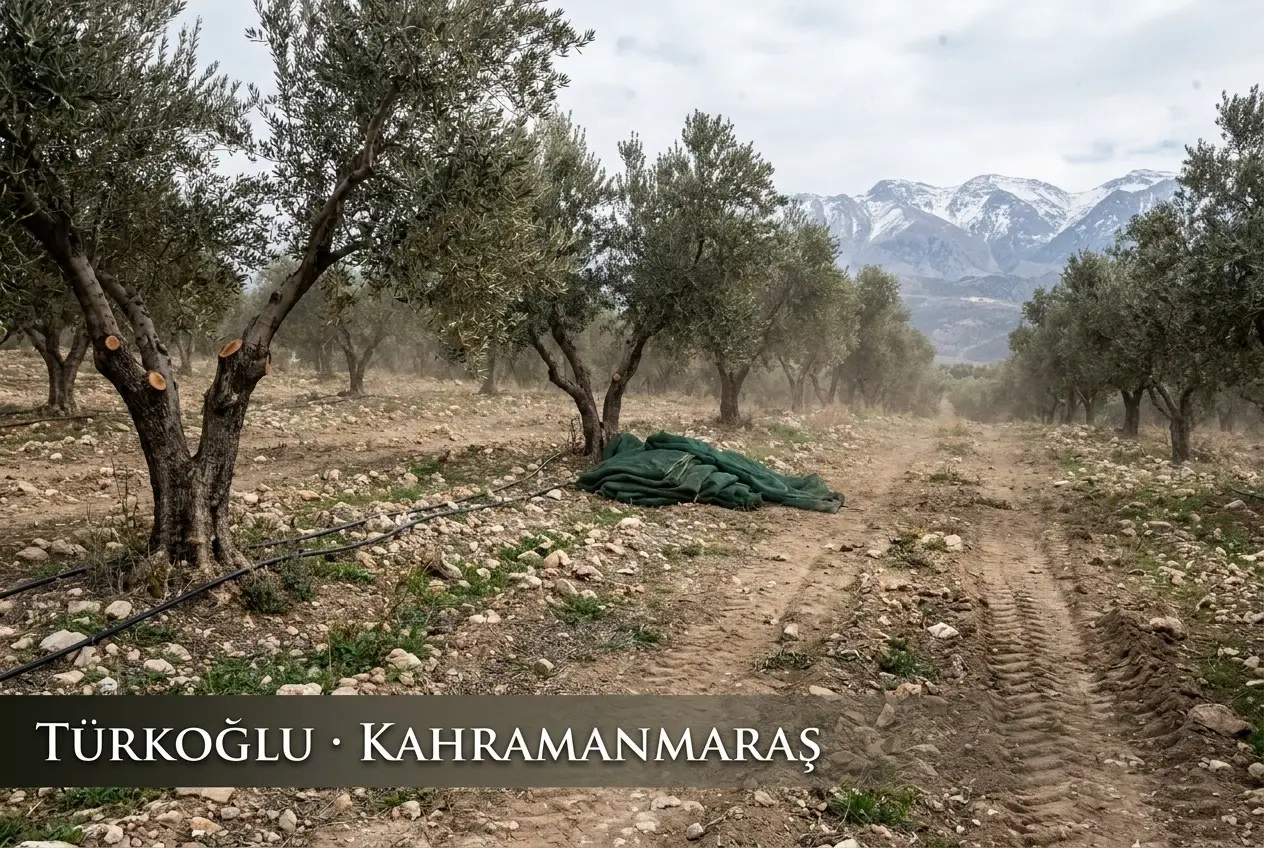
Türkoğlu — The Mediterranean's Rising Edge
Kahramanmaraş sits on the transition between the Mediterranean and the Southeast — a high-altitude, young olive district. We source Kilis and Nizip oil varieties from Türkoğlu's mills.
Kahramanmaraş is the northernmost and highest point on our sourcing map. The province sits squarely on the transition between Mediterranean and continental climates: Mediterranean influence dominates in the south, softening into a mild continental pattern further north. Elevation ranges from 350 to 3,000 metres, with average annual rainfall of 723 mm. Olive is not ornamental here — it grows as a natural component of the maquis between 500 and 1,200 metres. The sharp altitude shifts and cool mountain air slow down the vegetative cycle of the olive tree, allowing the fruit to mature at a much steadier pace than in coastal lowlands. This high-elevation microclimate gives Kahramanmaraş zeytinyağı a distinctive chemical balance, marked by firm fruit structure and pronounced herbaceous notes.
Which districts actually grow olives?
Olive growing is not spread across the province; it concentrates in five districts: Dulkadiroğlu, Onikişubat, Türkoğlu, Pazarcık and Andırın. More than half of the oil-olive trees stand in Dulkadiroğlu, while the largest share of young trees not yet bearing fruit is in Türkoğlu — meaning the area's capacity is still growing.
Three of the province's five olive oil facilities are in Türkoğlu, the other two in the central districts. That makes Türkoğlu the milling centre of gravity. For producers and commercial buyers alike, this geographic concentration is decisive. Once an olive is severed from the branch, cellular breakdown begins, and ambient warmth triggers enzymatic activity that steadily raises free acidity (serbest asitlik). Having modern continuous processing plants situated right in the production belt of Türkoğlu means fruit harvested on terraced hillsides can reach the mill without sitting in sacks for days. By ensuring rapid transfer to cold extraction (soğuk sıkım) systems operating below 27°C, Türkoğlu zeytinyağı preserves its natural phenolic compounds and retains the delicate aromatics of fresh fruit.
Varieties
The dominant varieties differ from those of the western Mediterranean; the Southeast's oil varieties reach this far:
- Kilis Yağlık and Nizip Yağlık — the defining oil varieties here, known for their high oil accumulation and robust profile
- Gemlik — common for both table and oil, adapting well to moderate valley slopes
- Traditionally Yağlık Sarı, Yağlık Siyah, Memecik and Yağ Çelebi; a small amount of Maraş 7
While Kilis and Nizip types are primarily pressed for oil, dual-purpose varieties such as Gemlik and local cultivars are frequently harvested for table olive preparation (sofralık zeytin). Depending on the maturity stage at harvest, hand-picked green and turning olives are cured as brine-cured table olives (salamuralık zeytin), providing local farmers with a diversified agricultural output alongside oil pressing.
The region in numbers
Official statistics put more than 1.8 million olive trees across 7,173 hectares, roughly 871,000 of them of bearing age. Annual production runs at about 6,950 tonnes — 2,573 for the table, 4,377 for oil. That is around 0.9% of Türkiye's olive area.
Official sector reports are candid about why yields are not higher: a large share of the groves sit on stony slopes and are poorly maintained. That is a weakness, but also headroom — pruning and care noticeably lift what the same trees deliver. Many orchards are planted on steep terrain inaccessible to heavy machinery, making soil tillage, systematic irrigation, and canopy management challenging. When trees are left unpruned, light penetration decreases, leading to alternate bearing patterns and sub-optimal fruit yields. However, as local agricultural practices gradually modernize, systematic soil nutrition and disciplined pruning are proving that these existing groves can produce significantly higher tonnage without expanding the cultivated footprint.
Why we source here
Altitude means later ripening and slower oil accumulation, which shifts the harvest calendar away from the Adana and Hatay plains: when the lowlands finish, the Maraş highlands are only just ripening. That extension of the season matters to us — it keeps us from depending on a single harvest window. In lower elevations, early harvest (erken hasat) operations often conclude before mid-autumn, whereas in Kahramanmaraş, fruit harvested at higher elevations allows for an extended production period extending deeper into the late autumn and early winter.
To be straight about it, Kahramanmaraş holds no geographical indication for olive oil; we claim no registered identity like Mut's. Its value is not in registration but in altitude, varietal difference and late harvest.
Grading, Quality Control, and Supply Channels
Every lot of olive oil we source from Kahramanmaraş undergoes physical and chemical classification before entering our inventory. Samples are analyzed for serbest asitlik in our in-house laboratory in Düziçi to categorize the pressings into clear quality tiers: extra virgin olive oil (natürel sızma zeytinyağı) with acidity at or below 0.8%, virgin olive oil (natürel birinci zeytinyağı), refined olive oil (rafine zeytinyağı), and blended riviera zeytinyağı. Please note that our Düziçi laboratory analyses are conducted strictly for internal grading and operational guidance, serving an informative purpose rather than acting as an accredited official document.
We supply both wholesale olive oil (toptan zeytinyağı) and retail olive oil (perakende zeytinyağı) across diverse market channels. Our packaging range accommodates every operational scale, including 1-litre glass bottles for retail shelves and home kitchens (evsel tüketim), 5-litre tin containers, 16 kg tins preferred by commercial caterers, hotels, and restaurants (otel ve restoran / HORECA), as well as bulk road tanker deliveries up to 25 tons for bottling plants and export partners. To maintain original chemical and sensory characteristics, finished oils must be stored in cool, dark environments away from direct sunlight, ambient heat, and oxygen exposure.
For regional growers looking to sell their harvest, we offer free sample analysis, on-site price quotations, transparent weighing, and direct payment terms. Commercial buyers and retail customers can manage their procurement through our online order (online sipariş) system or request real-time pricing by phone. We provide individual or corporate billing with payment accepted via bank transfer (EFT/havale) or credit card, supported by regular cargo (kargo) and road transport logistics reaching all 81 provinces of Türkiye.
Get in touch
Growers: our buying page. Looking for this area's produce? The contact form is open.