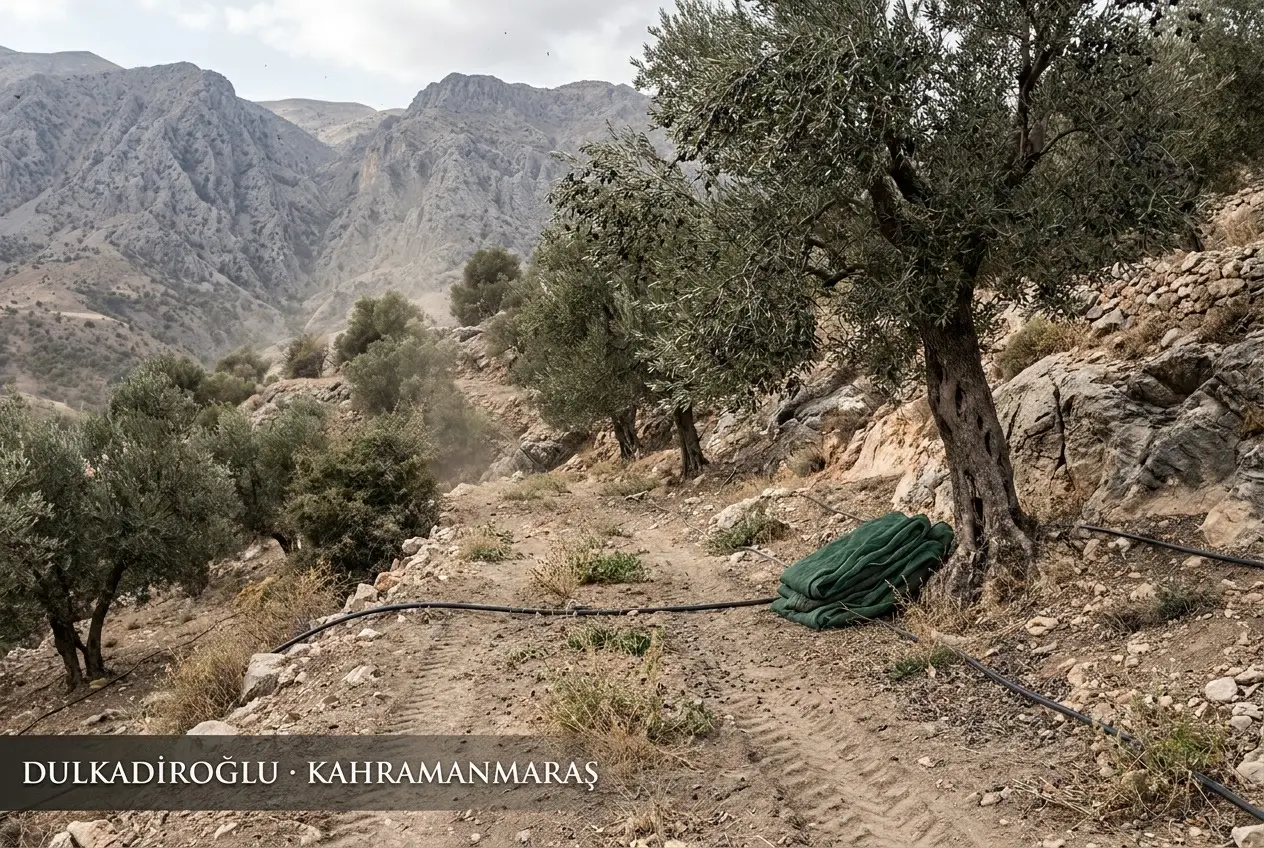
Dulkadiroğlu — Maraş's Oil-Olive Trees
More than half of Kahramanmaraş's oil-olive trees stand in Dulkadiroğlu — a district whose late harvest extends our season.
Olive growing in Kahramanmaraş concentrates in five districts, and more than half of the province's oil-olive trees stand in Dulkadiroğlu. It is the decisive district for the province's oil production. Located at the transitional threshold between steep mountain ranges and inland valleys, the agricultural output of Dulkadiroğlu zeytinyağı reflects an environment distinct from typical Mediterranean coastal groves. For commercial supply managers and discerning private buyers, understanding the geography of this district explains why its harvest window, fruit behavior, and processing requirements follow their own specific rules.
Why we source here
The answer is one word: calendar. Kahramanmaraş sits on the transition between the Mediterranean and the Southeast, with elevation running from 350 to 3,000 metres. Altitude means later ripening. When harvest finishes in plain districts like Toprakkale, the Maraş highlands are only just coming ready.
For us that is a commercial advantage: we are not tied to a single picking window and can extend the season by several weeks — which matters directly to wholesale buyers who need uninterrupted supply. Early harvest (erken hasat) fruit collected from these high elevations retains crisp sensory attributes and low free acidity (serbest asitlik) at a time when lowland harvests have already concluded. Squeezed through cold press (soğuk sıkım) methods, keeping processing temperatures low and transport times short, this delayed mountain crop allows us to supply freshly milled natürel sızma zeytinyağı well into the later months of the agricultural year.
Different varieties
The varieties here differ from those of the western Mediterranean; the Southeast's oil varieties reach this far. The main ones are Kilis Yağlık, Nizip Yağlık and Gemlik, with traditional Yağlık Sarı, Yağlık Siyah, Memecik and Yağ Çelebi also grown.
This varietal blend serves multiple purposes across the trade. While Gemlik and Yağ Çelebi frequently supply markets for brined table olives (salamuralık sofralık zeytin) and traditional sofralık zeytin preparations, Kilis Yağlık and Nizip Yağlık remain foundational to regional oil extraction due to their resilient structure and solid yield. Meanwhile, Yağlık Sarı and Yağlık Siyah contribute localized flavor depth to Kahramanmaraş zeytinyağı, yielding oils that withstand fluctuating continental temperatures and dry mountain summers.
The honest picture
Provincial olive production runs at about 6,950 tonnes, roughly 0.9% of Türkiye's olive area — this is not a region on the scale of Hatay or Mersin. Official reports are candid about why yields stay low: a large share of the groves sit on stony slopes and are poorly maintained.
Kahramanmaraş holds no geographical indication for olive oil, and we claim no registered identity here. Its value lies in altitude and late harvest, not registration. The rocky terrain makes mechanical harvesting largely impractical, requiring intensive hand picking on terraced slopes. Rather than presenting this district through unverified marketing claims, we manage it through disciplined selection: each incoming lot is evaluated individually, separating fruit compromised by terrain challenges from parcels that meet our standards for premium extraction.
From mountain grove to oil classification
Because fruit picked on high slopes can degrade if left waiting in sacks, timely transport and rapid milling are critical. Olives that sit too long undergo fermentation, which rapidly increases serbest asitlik and damages organoleptic balance. Upon delivery, we analyze incoming batches at our own laboratory in Düziçi to measure free acidity and monitor purity indicators. This internal testing is strictly for operational classification and informational guidance, serving as our baseline for sorting raw material into proper grades rather than functioning as an official accredited document.
Through this measurement process, oils derived from Dulkadiroğlu fruit are separated into clearly defined categories:
Natürel sızma zeytinyağı: Cold-pressed from sound early harvest olives, delivering low acidity, natural freshness, and balanced bitterness for direct culinary application.
Natürel birinci zeytinyağı: Virgin grade oil with slightly higher acidity thresholds, well-suited for everyday cooking, hot dishes, and commercial food preparation.
Rafine zeytinyağı & Riviera zeytinyağı: Refined olive oil and blended riviera zeytinyağı formulations suited for high-heat frying, bakery production, and institutional catering requiring mild taste and steady performance.
Ordering and shipping
We grade what comes from this district as extra virgin, virgin, refined or olive oil (riviera). Retail in 1 L and 5 L; wholesale in 16 kg tins and bulk. Leave a request — payment by bank transfer or credit card, invoiced to a company or an individual, shipped nationwide.
We supply diverse commercial channels including otel ve restoran operations, catering companies, local grocery markets, export houses, and individual buyers for home use (evsel tüketim). For retail and domestic kitchens, we bottle in 1 L glass and 5 L tins designed to shield the oil from UV light and oxygen exposure. For toptan zeytinyağı clients, we provide standard 16 kg industrial tins, food-grade drums, and road tanker shipments up to 25 tonnes.
Purchasing is straightforward: clients can request quotes by phone or submit an online sipariş form. We accept payment via wire transfer (havale/EFT) or credit card, issue institutional or individual invoices, and dispatch reliable kargo and freight shipments to all 81 provinces of Türkiye.
If you grow olives here, see our buying page — sample analysis is free. Local growers receive on-site price assessments, accurate weighing, and direct payment based on objective laboratory testing of their crop.