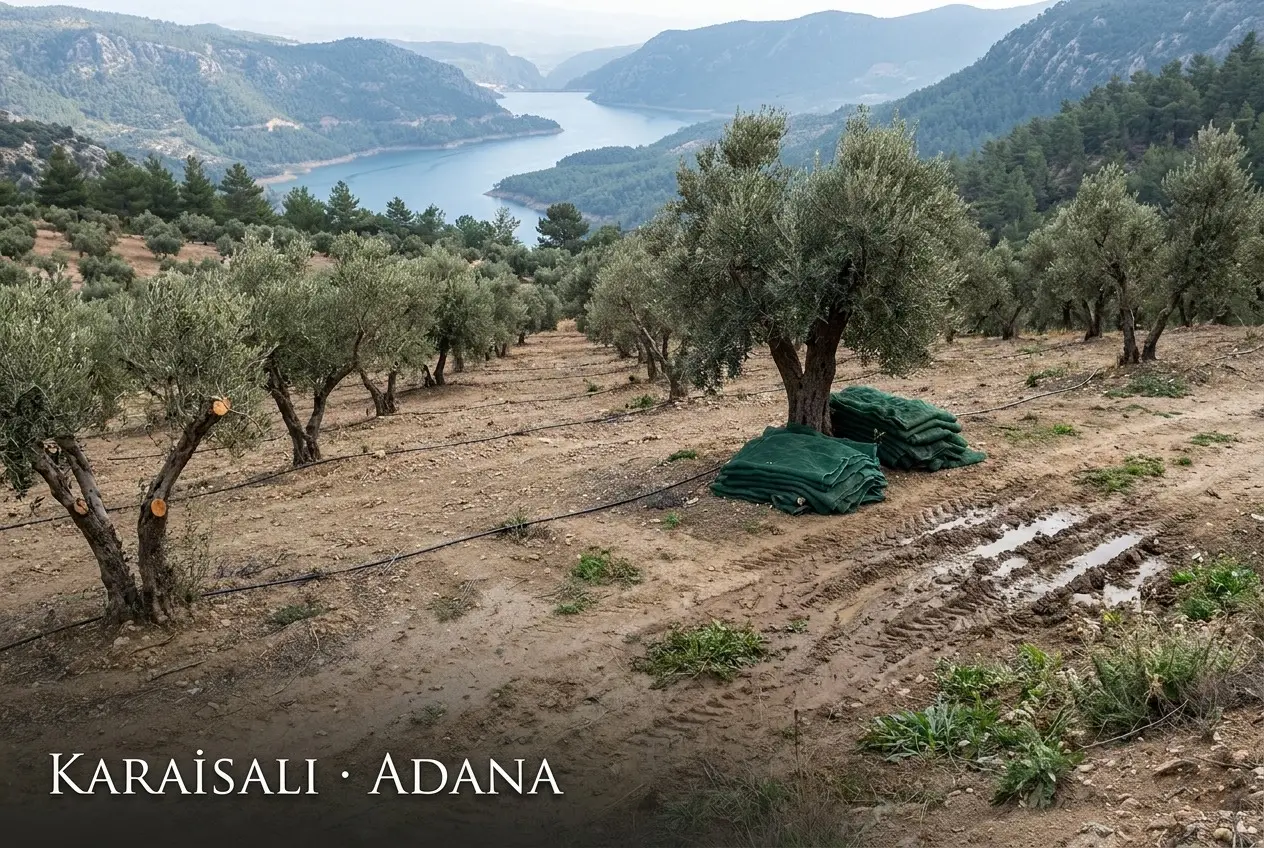
Karaisalı — Above the Seyhan
Karaisalı sits north of the Çukurova in the upper Seyhan basin — higher and cooler than the plain, and a source of oil olives for us.
Karaisalı lies north of Adana in the upper Seyhan basin, on ground that rises from the hot Çukurova flat toward the Taurus mountains. Several agricultural sources name it Adana's largest olive district. As the Mediterranean landscape transitions from open alluvial plains into rolling limestone ridges, the microclimate shifts distinctly. This geographical gradient defines the physical structure of local groves and sets Karaisalı zeytinyağı apart within the broader profile of Adana zeytinyağı.
The terrain here is shaped by natural drainage channels, rocky outcrops, and varying slope exposures. Instead of the uninterrupted, intensive monoculture seen on the low plains, olive parcels in Karaisalı are frequently interspersed with valley shrubland and pine margins. These environmental conditions affect how the trees interact with seasonal heat, soil moisture, and prevailing winds throughout the vegetative cycle.
What changes as you climb off the plain
For olive production, altitude changes three things at once. First, harvest timing: fruit ripens later higher up the foothills than it does on the sea-level flatlands. While growers on the plain may begin picking in early autumn, Karaisalı operates on a deferred schedule. An erken hasat (early harvest) in these upland parcels captures green, firm fruit with high natural resistance to oxidation, allowing the production of natürel sızma zeytinyağı (extra virgin olive oil) that retains fresh grassy and herbaceous notes when processed quickly after picking.
Second, the day–night temperature gap: it widens noticeably with elevation. Cool mountain air descending from the Taurus range at night breaks the daytime summer heat, creating conditions that favour the accumulation of aroma and phenolic compounds within the olive skin and pulp. When extracted using modern soğuk sıkım (cold press) systems—keeping paste temperatures below 27°C—this fruit yields oil with balanced bitterness and pungency, rather than the flat, heat-stressed character common in overly warm lowlands.
Third, disease pressure: on cool, airy ground, humidity-related issues such as the olive fruit fly and fungal leaf infections press less hard than they do on the heavy, stagnant air of the valley bottoms. Well-ventilated hillside canopies dry quickly after autumn rains, which helps keep the fruit skin intact on the branch and prevents premature decay that would otherwise spike the serbest asitlik (free acidity) of the pressed oil.
So districts like Karaisalı offer a different calendar and a different character from the Ceyhan plain, despite sharing a province. That variety is valuable to us in sourcing, giving us access to fruit that matures at different speeds and fills distinct compositional roles in our seasonal tank allocations.
The Seyhan basin
The district sits in the river's upper basin. Water availability is one of the factors shaping farming here, and groves generally follow the line of valley and slope. Runoff from the higher mountain slopes feeds localized aquifer zones and seasonal streams, creating micro-pockets of deep, well-drained soil adjacent to dry, stony limestone hillsides.
Because soil depth and water retention vary from one ridge to the next, parcel management is diverse. Some growers cultivate hearty dual-purpose varieties geared toward salamuralık sofralık zeytin (brined table olives), where fruit size, firmness, and clean skin are the primary targets for table preparation. Other groves are maintained exclusively for oil extraction, where trees are pruned to optimize sun exposure across the entire canopy, concentrating oil content within the fruit flesh.
The honest picture
Karaisalı appears repeatedly as Adana's leading olive district and is regularly counted among the province's olive observation districts in national crop-estimate work. Even so, no official district-level table (tonnes, trees, area) is published openly, so we give no numbers here — figures circulating online could not be confirmed at source. Our measure is always the same: the sample analysis.
Do not look for a registered olive oil name in Karaisalı — Adana has no such geographical indication. The district is however recorded under “Olive – Olive Oil” in the Ministry's basin support scheme; here the cool air of higher ground tells in the harvest calendar rather than in a registration.
What we source here
Mostly oil fruit. When working with growers in Karaisalı, we conduct direct field purchasing based on objective laboratory testing. We offer free sample analysis to local producers, taking representative lots directly from harvest crates or farm storage. Grading is done by serbest asitlik (free acidity) measurement at our Düziçi lab: extra virgin (natürel sızma zeytinyağı), virgin (natürel birinci zeytinyağı), refined (rafine zeytinyağı), and olive oil (riviera zeytinyağı). Please note that our internal laboratory testing is conducted for sourcing, grading, and commercial guidance; it serves as informative quality control and does not replace an official accredited document.
Batches with low acidity and pristine sensory profiles are routed into our extra virgin lines, protected from oxygen, light, and elevated temperatures in stainless steel storage. Oils exhibiting higher natural acidity or mild structural defects are classified as natural virgin or directed to specialized refining to produce stable rafine zeytinyağı and balanced riviera zeytinyağı suitable for high-heat cooking applications.
We pack and distribute these oils across diverse commercial channels. For retail markets, grocers, and individual evsel tüketim (household consumption), we supply perakende zeytinyağı in protective 1-litre glass bottles and practical 5-litre tins. For wholesale buyers, commercial kitchens, catering operations, and the otel ve restoran (HORECA) sector, our toptan zeytinyağı range is packaged in heavy-duty 16 kg tins, as well as road tanker consignments up to 25 tonnes for industrial and packaging facilities.
Leave an order request through our online sipariş system or contact our team directly for current batch specifications and price lists. We provide formal commercial or individual invoicing, accept payment by bank transfer (EFT) or credit card, and arrange reliable kargo and freight logistics across all 81 provinces of Turkey.