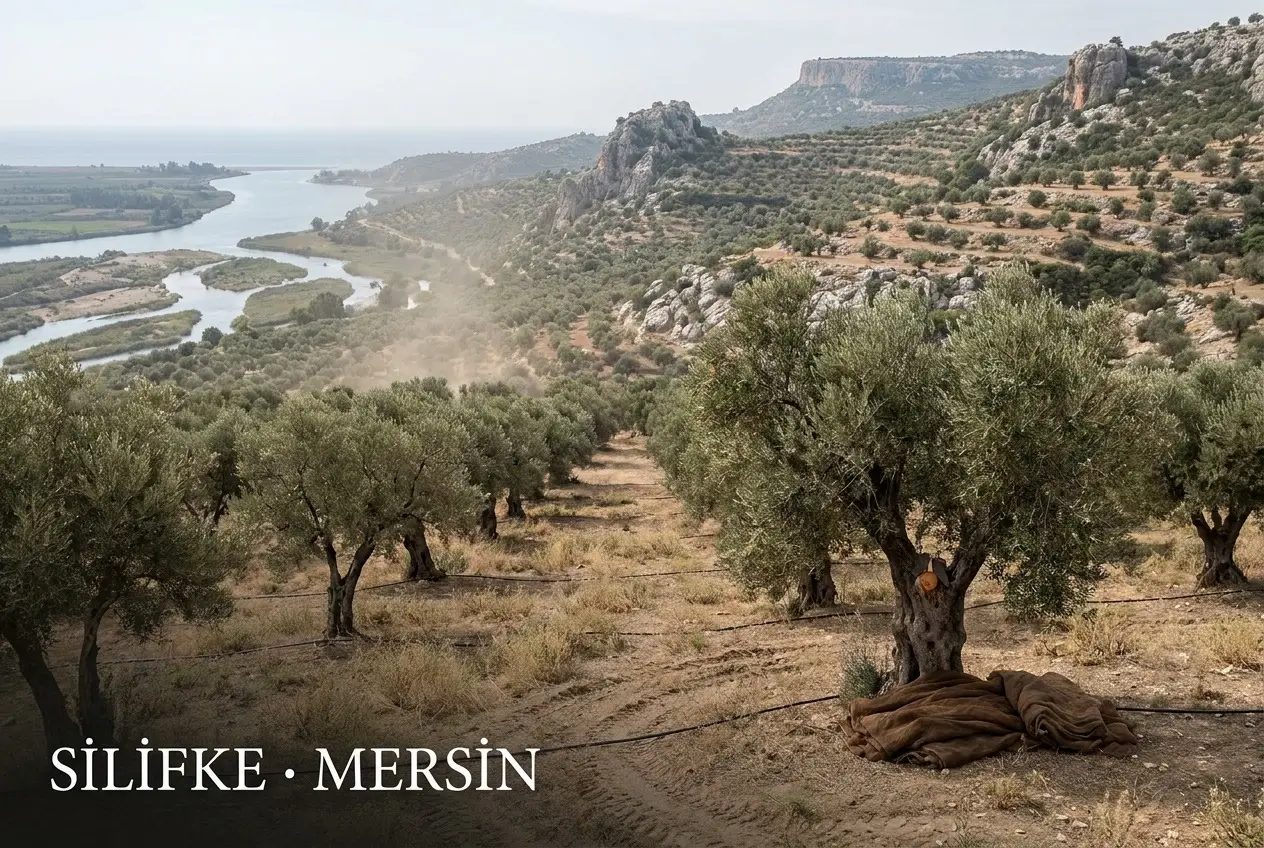
Silifke — The Göksu Valley and Its Own Variety
Silifke gave its name to an olive variety of its own — Silifke Yağlık — in a district stretching between the Göksu valley and the central Taurus foothills.
There is a simple way to gauge how deep-rooted a district's olive growing is: does a variety carry its name? In Silifke one does — Silifke Yağlık.
A variety named after the place
When a variety is known by a place name, it means that tree has been selected and propagated there over a long period — it adapted, it took, and it came to be called by that name. As the name suggests, Silifke Yağlık is grown mainly for oil. Across the broader agricultural landscape of Mersin zeytinyağı production, cultivars like Silifke Yağlık demonstrate resilience to dry Mediterranean summers, deep limestone soils, and coastal heat, yielding an oil profile shaped by local microclimates.
Between the Göksu valley and the Taurus foothills
Silifke stretches between the broad valley where the Göksu river reaches the sea and the foothills of the central Taurus. That gives the district a marked range of elevation, from valley floor at sea level up to the mountain skirts.
Elevation translates directly into harvest calendar. Groves on the valley floor ripen first; those higher up follow weeks later. That internal shift is useful to us in sourcing — together with the high valley of neighbouring Mut, it widens the buying window on the Mersin side.
This topographical variation also determines fruit management. When olives are harvested on the lower plains during the early harvest (erken hasat) phase, daytime warmth makes prompt transport essential. If harvested olives sit in sacks or unventilated containers, cellular respiration increases fruit temperature and accelerates hydrolytic degradation. To prevent a rise in free acidity (serbest asitlik) and preserve natural polyphenols, fruit must be transferred without delay to extraction plants for cold press (soğuk sıkım) processing. Pressing at controlled temperatures ensures that the distinctive characteristics of Silifke zeytinyağı remain intact.
Scale
According to the Silifke chamber of agriculture, the district carries around 2 million olive trees across 4,200 hectares, producing 40,000–45,000 tonnes a year. Development-agency reports likewise place Mersin's olive concentration in Tarsus, Erdemli, Silifke and Mut — Silifke among those four.
The provincial view completes the picture: Mersin holds more than 11 million bearing olive trees and produces over 300,000 tonnes a year, making it the largest olive province in the eastern Mediterranean.
One caveat stated plainly: tree and production figures published by different institutions diverge noticeably, because methods and definitions differ. We therefore give figures with their source rather than blending them.
Laboratory analysis and oil classification
Every lot extracted from regional harvests displays slight differences in chemistry based on harvest time, tree location, and climatic conditions during the growing cycle. In our own laboratory in Düziçi, we test every incoming batch for free acidity levels to determine its precise commercial category. Our internal testing is performed for grading and informational purposes; it provides clear guidance for our procurement and sales operations, though it does not replace an official accredited certificate.
Depending on measured acidity and organoleptic assessment, the oil is sorted into distinct categories: extra virgin olive oil (natürel sızma zeytinyağı) for cold dishes and table use, virgin olive oil (natürel birinci zeytinyağı) for balanced daily cooking, refined olive oil (rafine zeytinyağı) for neutral culinary needs, and blended olive oil (riviera zeytinyağı) for versatile kitchen frying and baking. In seasons where the harvest permits, high-grade table olives (sofralık zeytin and salamuralık zeytin) are also prepared under traditional brining methods.
Direct procurement from Göksu basin growers
Working directly with agricultural producers along the Göksu basin allows us to inspect fruit condition before pressing takes place. When buying from local farmers, we provide free sample analysis on site. We evaluate acidity and quality parameters, provide an immediate purchase offer, and carry out transparent weighing and payment on the spot. Sourcing directly from regional groves guarantees traceable raw material flow from tree to storage tank.
What we source here
Mostly oil fruit. After pressing we grade by free acidity: extra virgin, virgin, refined and olive oil (riviera). Our guide explains the differences.
We pack bottles and tins for retail and household use, and ship bulk for wholesale. Our commercial supply caters to bulk purchasers (toptan zeytinyağı), food service operators, catering companies, and the hospitality sector (otel ve restoran), as well as grocery networks and retail stores (perakende zeytinyağı). We also provide standard packaging for home kitchens and domestic household consumption (evsel tüketim).
Our standard packaging range includes:
• 1 litre dark glass bottles for table service and retail displays
• 5 litre tins for household storage and commercial pantries
• 16 kg tins for institutional kitchens and catering facilities
• Bulk tanker shipments up to 25 tonnes for industrial bottling and export requirements
Logistics are coordinated through contracted freight carriers and parcel services (kargo) reaching all 81 provinces of Turkey. Buyers can place orders via our online order form (online sipariş) or contact our sales team by phone for real-time pricing. Invoicing is available for both corporate and individual accounts, with payments processed securely through bank transfer (havale/EFT) or credit card. Leave a request — price, payment (bank transfer or credit card) and delivery are settled by phone.