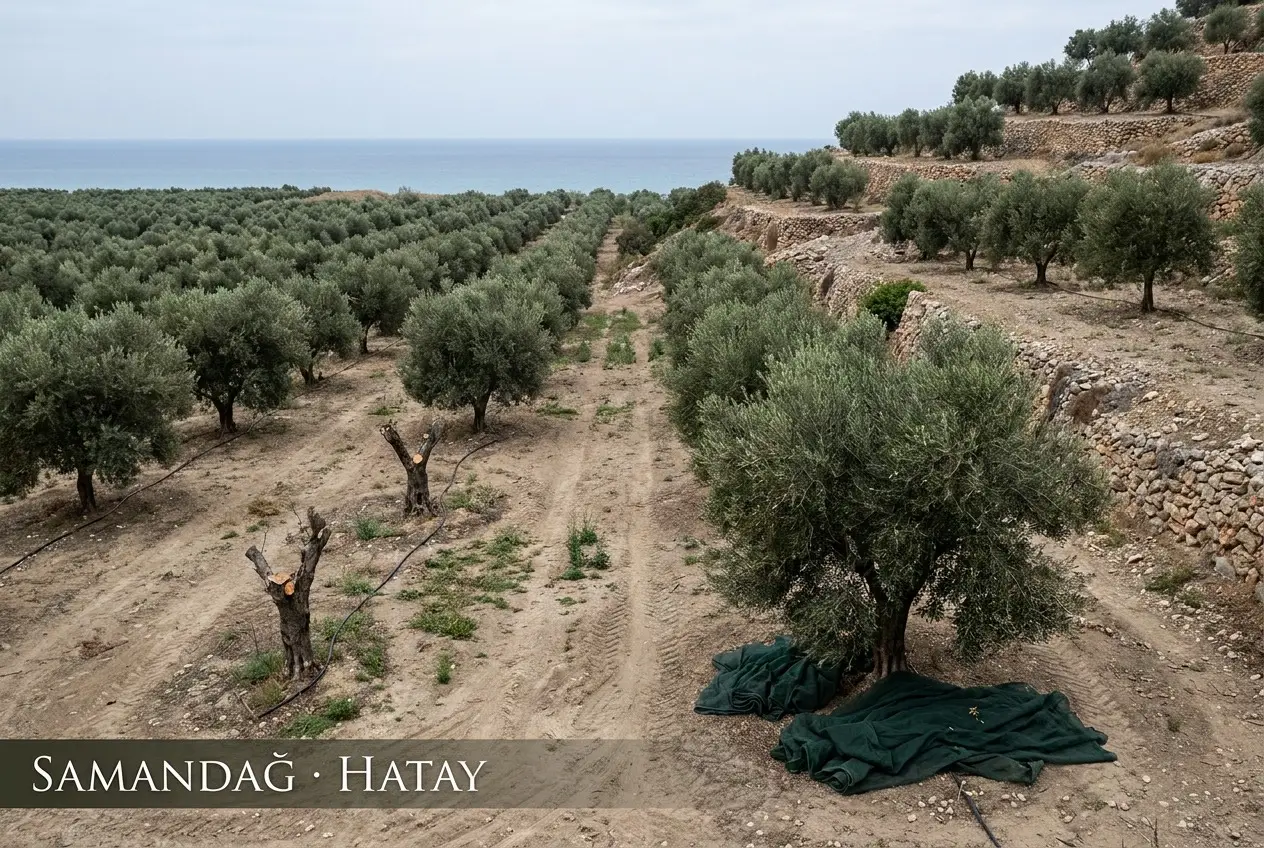
Samandağ — The Orontes Delta and Musa Dağı
Samandağ stretches between the delta where the Orontes meets the sea and the slopes of Musa Dağı — two landscapes yielding two olive characters from one district.
Samandağ carries close to 1.5 million trees across 4,487 hectares and produces 19,723 tonnes of olives a year — one of Hatay's most productive districts. Positioned at the southwestern corner of the province where the Mediterranean maritime climate creates prolonged humidity and mild winters, Samandağ holds a distinct position in the production of genuine Hatay zeytinyağı.
Two landscapes in one district
What makes Samandağ interesting is its geographic split. One side is the delta where the Orontes (Asi) meets the sea: alluvial, deep, feeding soil. The other is the slopes of Musa Dağı: stony, steep, free-draining.
The two grounds produce two different crops from one district. Trees on the delta side benefit from continuous moisture and rich river deposits, giving larger fruit and higher yields. Trees on the rocky slopes face harsher water stress and thinner soils; they give less fruit, but the olives yield an oil of denser character and sharper aromatic concentration. That is why, when buying raw crop or freshly pressed oil from the area, we always establish which side of the district a grove sits on.
Harvesting on the mountain slopes requires manual labor on terraces where machinery cannot operate, which naturally raises picking times. On the delta floor, harvesting is faster, but the higher ambient humidity means picked fruit must be transported to the mill immediately. Any delay causes bruised fruit to ferment, raising the free acidity (serbest asitlik) levels before milling even begins.
Citrus and greenhouse vegetables are also strong in the district's farming identity — Samandağ is not an olive-only place. Parcels of olive groves often border citrus orchards and vegetable tunnels. Yet, despite sharing fertile acreage with cash crops, its olive area and output rank near the top of the province.
Table olives come from here too
Hatay is known for its registered local varieties: Halhalı, Saurani and Sarı Haşebi, alongside Karamani, Gemlik and Sarı Ulak. Table use is strong here, and a significant share of our brine and cracked table olive supply comes from this area.
Varieties like Halhalı and Saurani are dual-purpose. When picked in early harvest (erken hasat) as green fruit, they are processed into cracked or whole salamuralık zeytin (brine table olives) and traditional sofralık zeytin. Their firm skin and balanced flesh-to-pit ratio hold up well under natural brine preservation without softening prematurely.
Fruit left to mature on the branch turns from purple to black, shifting its balance toward higher oil content. When milled under strict cold press (soğuk sıkım) conditions where the paste temperature remains low during extraction, these varieties yield authentic Samandağ zeytinyağı marked by regional character. Olives that show physical defects or high skin oxidation during late picking are separated from direct extra virgin processing and directed toward refining lines.
Acidity testing, processing, and grades
Quality in olive oil is defined by chemical and sensory parameters, with free fatty acid percentage serving as the primary baseline. When lots arrive from the groves of Samandağ, representative samples are evaluated in our own laboratory in Düziçi for free acidity measurement. This internal analysis is conducted purely for informational grading and batch sorting; it does not replace an official accredited certificate, but it guarantees that every lot is assigned to its exact commercial standard:
- Natürel sızma zeytinyağı (Extra virgin olive oil): Direct cold-pressed oil with flawless aroma and low serbest asitlik, ideal for raw consumption, dipping, and fresh dressings.
- Natürel birinci zeytinyağı (Virgin olive oil): A softer culinary profile with slightly higher acidity parameters, suited for everyday cooking.
- Rafine zeytinyağı (Refined olive oil): Clear, neutral oil processed from higher-acid raw lots through modern refining methods without compromising lipid integrity.
- Riviera zeytinyağı (Riviera olive oil): A balanced blend combining refined oil with natural virgin oils to deliver a mild taste suitable for high-heat cooking and frying.
Commercial supply and packaging formats
We work with both sides of the market. For local growers in Samandağ, we offer direct procurement with free sample analysis, on-site weighing, transparent valuation, and immediate payment. For commercial buyers, we provide stable volume across the year, shielding businesses from harvest fluctuations.
Our packaging infrastructure caters to diverse market channels:
- 1-litre glass bottles: Targeted at retail zeytinyağı distribution, grocery shelves, boutique markets, and high-end evsel tüketim (household consumption).
- 5-litre tins: The standard format for family kitchens, professional cooking lines, and smaller catering operations.
- 16 kg tins: Tailored for wholesale zeytinyağı (toptan zeytinyağı) requirements in the otel ve restoran (HORECA) sector, food manufacturing, and institutional kitchens.
- Bulk supply up to 25 tonnes: Handled in specialized food-grade transport containers and flexitanks for industrial repackagers and international export partners.
Ordering and shipping
One tin or a full truck — the scale does not matter. Leave a request and our team will call with current pricing and payment options; pay by bank transfer or credit card, and ask for a company or personal invoice. Retail requests placed through the online order form travel by contracted courier; bulk orders go on our own or a contracted haulier. We ship to all 81 provinces of Türkiye.
Get in touch
Our buying page is for growers; our products page is for buyers. Both lead to the contact form.