Olive pomace oil is the most misunderstood product on the olive oil shelf, and the confusion starts with its name. Spain calls it aceite de orujo, Italy olio di sansa, Türkiye pirina yağı. English-language marketing has settled on “pomace olive oil”, which reads as a variety of olive oil — a subtle reversal of what the standards actually say.
So let us put the answer first, then spend the rest of this piece earning it. Olive pomace oil is a real vegetable oil made from real olives. It is not a fake, and it is not olive oil. It has its own legal category, its own chemistry, its own contaminant limits and its own job in the kitchen. Every argument about it — safety, frying, price, adulteration — makes sense once you know how it is made.
Our olive pomace oil guide covers the category definition. This article goes further down: the mass balance, the solvent question, the regulatory numbers, and the measurements from published frying trials.
Start with a mass balance
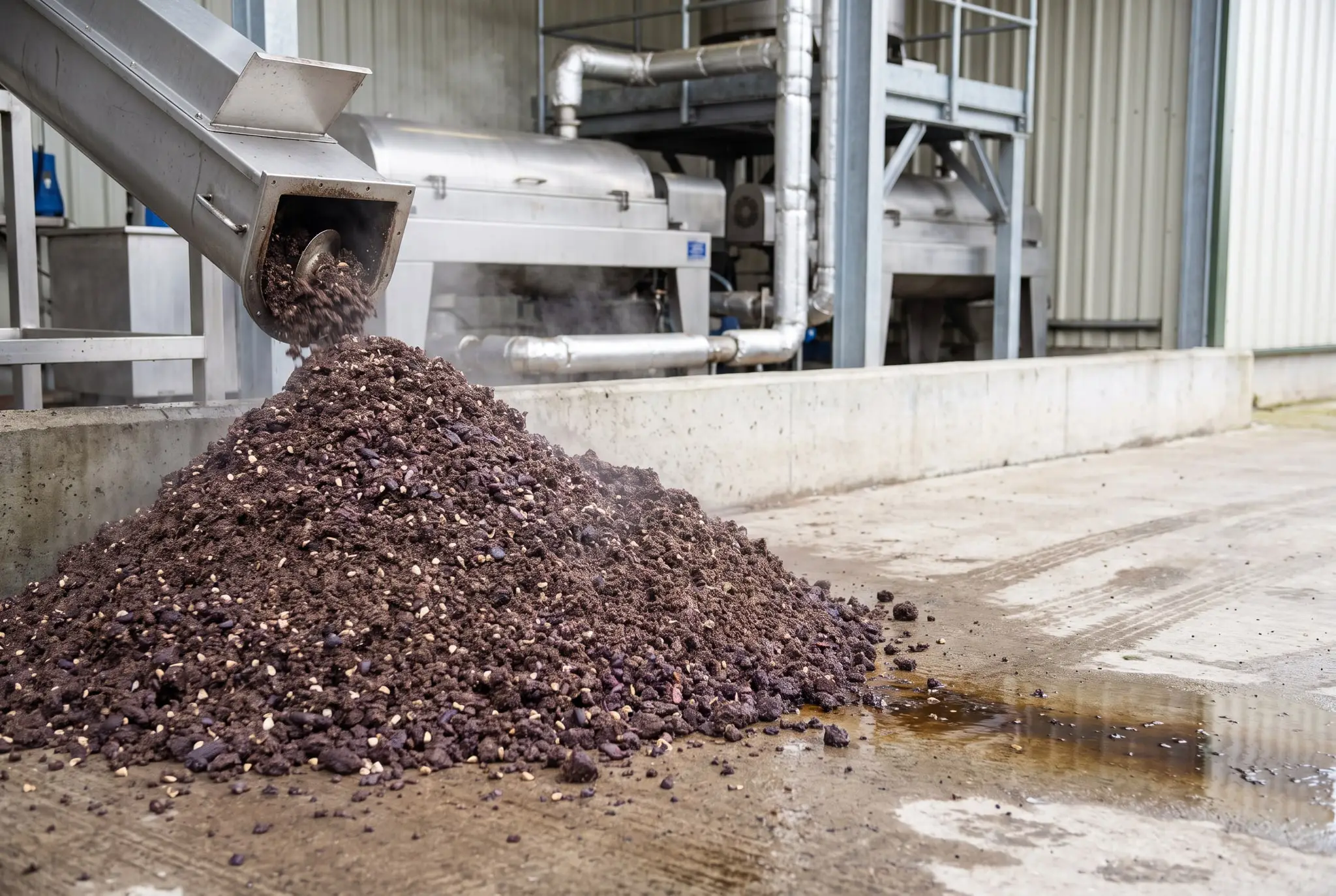
Crush olives, malax the paste, run it through a decanter, and three things come out: oil, vegetation water, and a solid residue of skin, pulp and crushed stone. That residue is the pomace.
There is far more of it than most people assume. As a working figure used in the industry, producing one tonne of olive oil leaves roughly 3.75 tonnes of pomace in a two-phase mill and roughly 2.50 tonnes in a three-phase mill. Olive oil production is, by weight, mostly a residue-producing business.
That residue is not dry, and how wet it is decides everything downstream:
- Traditional press pomace: 25–30% moisture.
- Three-phase pomace: 40–55% moisture. Process water is added at the decanter, so the vegetation water leaves separately and the solids come out drier.
- Two-phase pomace (alperujo): 60–70% moisture. No water is added, so the vegetation water stays in the solids. It cannot be stockpiled; it has to be held in ponds and de-watered before anything else can happen.
The two-phase decanter was adopted across Spain and elsewhere because it uses less water and generates no separate waste stream — an environmental win at the mill that hands the pomace plant a wetter, stickier, more expensive problem. Two-phase pomace also has a higher sugar content and tends to agglomerate on hot dryer walls.
And the residue still holds oil the decanter could not reach — but not much of it, in absolute terms. Industry figures from Türkiye put the yield at roughly 45 litres of pomace oil per tonne of two-phase pomace and 50 litres per tonne of three-phase pomace. That one line explains the entire economics of the sector: you must move, dry, extract and refine a tonne of wet residue to recover about a barrel’s worth of oil, which is why pomace plants run at industrial scale and lean on a second revenue stream — selling the de-oiled solids as fuel.
Why solvent, and not more pressure
The oil left in pomace is bound in the cell structure of skin and pulp fragments. Pressing it harder does not release it economically: you spend more energy than the recovered oil is worth, and you still leave most of it behind. Washing the dried solids with a solvent does release it.
Worth noting that the standard does not make solvent the only permitted route — the definition reads “by treating olive pomace with solvents or other physical treatments”, and physically extracted pomace oil does exist. It is a small minority. Commercially, when you read “olive pomace oil”, assume hexane.
The solvent is food-grade hexane — a commercial product of six-carbon acyclic saturated hydrocarbons that distils between 64 °C and 70 °C. That low boiling range is the whole point. Oil boils far higher, so heat and vacuum strip the hexane out and it is recycled back into the extraction step.
Three things are worth knowing about the solvent question, because it is where most of the online argument lives:
- There is a legal residue limit. The EU extraction-solvents directive sets a maximum hexane residue of 1 mg/kg in vegetable oils and fats. The same directive forbids acetone in the refining of olive pomace oil specifically.
- There is an indirect check built into the trade standard. The International Olive Council requires crude olive pomace oil to have a flash point above 120 °C — a criterion applied to no other category. An oil carrying solvent residue ignites at a lower temperature, so flash point is a practical proxy for “the hexane is gone”.
- The solvent is a real hazard — at the plant, not in the bottle. Hexane is flammable, explosive and toxic. Its vapour is heavier than air and pools at ground level. This is why pomace plants sit away from residential areas and buy solvent under permit in capacity-limited quantities.
The honest framing is not “solvents are used, therefore avoid it”. It is: solvent extraction is a controlled industrial process with a measured residue limit, and the question worth asking of any given producer is whether they are measuring.
2001: the year pomace oil lost its reputation
Most of the lingering suspicion around pomace oil traces to a single summer. In July 2001, Spain halted movement of olive pomace oil after health authorities found benzo[a]pyrene, a polycyclic aromatic hydrocarbon and a known carcinogen. Portugal banned the trade outright and began seizing shipments; several importing countries suspended purchases. At the time the category represented around a tenth of Spain’s olive oil output and roughly 13,000 tonnes of annual exports to more than fifty countries.
The industry body Asoliva identified the cause quickly: pomace was being heated past recommended temperatures during drying, and the combustion gases were burning the residue. Spain authorised sales of production dated after 1 August 2001, and the crisis closed.
Two permanent changes came out of it, and both are why the modern product is a different proposition:
- Indirect drying. The conventional rotary dryer exposes pomace directly to a hot gas stream where temperatures can reach 400–800 °C, and that direct contact with combustion fumes is what raises PAH levels. Indirect systems keep the flue gas away from the product.
- Activated carbon in the bleaching step. Adsorbent treatment during refining binds and removes PAHs. It works — but only if the carbon itself is clean; contaminated adsorbent is a documented source of PAH contamination in edible oils.
Today the limits are explicit. Under the EU contaminants regulation, oils and fats must stay at or below 2 µg/kg benzo[a]pyrene and 10 µg/kg for the sum of four PAHs (benzo[a]pyrene, benz[a]anthracene, benzo[b]fluoranthene, chrysene). Exceeding either figure makes the product non-compliant.
What the trade standard actually says
The IOC trade standard (COI/T.15/NC No 3) defines three pomace categories, and its language on naming is unambiguous: “Olive pomace oil cannot be sold with the designation or definition ‘olive oil’.” The blend category adds a second sentence for good measure — “In no case shall this blend be called ‘olive oil’.”
Türkiye’s food code says the same thing in one line. The Turkish Food Codex Communiqué on Olive Oil and Olive Pomace Oil (No. 2017/26, published 17 September 2017, replacing 2010/35) states in Article 14 that pomace oil may under no circumstances be named olive oil, and Article 4 sets the same acidity limits as the IOC: 0.3 g/100 g for refined pomace oil, 1.0 g/100 g for the blend.
Here are the numbers from Rev. 20 of the IOC standard:
| Criterion | Crude olive pomace oil | Refined olive pomace oil | Olive pomace oil (blend) |
|---|---|---|---|
| Free acidity (% oleic) | no limit | < 0.30 | < 1.00 |
| Peroxide value (meq O₂/kg) | no limit | < 5.0 | < 15.0 |
| K268 | — | < 2.00 | < 1.70 |
| ΔK | — | < 0.20 | < 0.18 |
| Moisture and volatiles (%) | < 1.5 | < 0.1 | < 0.1 |
| Flash point | > 120 °C | — | — |
| Waxes C40+C42+C44+C46 (mg/kg) | > 350 | > 350 | > 350 |
| Erythrodiol + uvaol (% total sterols) | > 4.5 | > 4.5 | > 4.5 |
| Total sterols (mg/kg) | > 2,500 | > 1,800 | > 1,600 |
| Unsaponifiable matter (g/kg) | < 30 (olive oils: < 15) | ||
The “no limit” rows surprise people. They are there because crude pomace oil is not a consumer product — it is an intermediate destined for a refinery or for technical use. Quality limits attach at the point a human eats it.
How a laboratory tells the two apart
Not by taste. By two families of compounds that concentrate in the olive skin — which a press barely touches and a solvent strips completely.
- Waxes. Every olive oil category has an upper limit: < 150 mg/kg (C42+C44+C46) for extra virgin and virgin, < 350 mg/kg (C40+C42+C44+C46) for refined olive oil and the olive oil blend. Every pomace category has a lower limit on the same sum: > 350 mg/kg. One measurement, two products defined from opposite directions.
- Erythrodiol and uvaol. These triterpene dialcohols run < 4.5% of total sterols in edible virgin olive oils and > 4.5% in every pomace category.
The standard even handles the grey zone. An oil measuring between 300 and 350 mg/kg of waxes is classified as crude olive pomace oil if total aliphatic alcohols exceed 350 mg/kg and erythrodiol + uvaol exceeds 3.5%; the same oil is lampante virgin olive oil if those conditions are not met. Rules like this exist so that borderline lots are not decided by whoever is holding the paperwork.
Supporting criteria include total sterol content (> 1,000 mg/kg for olive oils, > 2,500 mg/kg for crude pomace oil), the ΔECN42 triacylglycerol difference, and 2-glyceryl monopalmitate. The last two fingerprint the triacylglycerol backbone — which fatty acid sits in which position on the glycerol molecule differs between oils, and blending disturbs the pattern. Our analysis values page walks through what each line on a report means, and adulteration and fraud covers which test catches which trick.
The three contaminant families, honestly
“Is pomace olive oil safe?” is the wrong shape of question. The useful version is: which process contaminants can form, what are the limits, and what controls them. There are three.
PAHs
Covered above: a drying-stage problem, controlled by indirect drying and activated carbon, limited at 2 µg/kg benzo[a]pyrene and 10 µg/kg PAH4.
3-MCPD esters and glycidyl esters
These are not a pomace phenomenon. They form during high-temperature deodorisation in any refined vegetable oil — sunflower, soy, palm, refined olive oil included. Measured levels are higher in refined and pomace olive oils than in extra virgin, which is exactly what you would expect, since extra virgin is never refined at all.
The EU caps glycidyl esters at 1.00 mg/kg in edible oils. For 3-MCPD esters there are two tiers: 1.25 mg/kg for a listed group including olive oil, and 2.5 mg/kg for other refined vegetable oils. Olive pomace oil is explicitly excluded from the olive oil tier and sits with the general refined oils — one more instance of the law treating it as a refined vegetable oil rather than as olive oil. Mitigation is a process matter: manage deodorisation temperature and residence time, reduce chloride precursors, use dual-stage deodorisation where needed.
Mineral oil hydrocarbons (MOSH/MOAH)
This is the live debate, and pomace oil is at its centre. Market surveys have found olive oils averaging 33.1 mg/kg MOSH and 3.3 mg/kg MOAH against olive pomace oils averaging 160.7 and 36.1 mg/kg.
A 2023 study reframed where that gap comes from. Comparing the same feedstock processed two ways, researchers measured 65–118 mg/kg MOSH and 1.8–28 mg/kg MOAH in physically extracted pomace oil, against 209–520 mg/kg MOSH and 54–115 mg/kg MOAH in hexane-extracted oil. Solvent extraction concentrates the hydrocarbons 2–6 fold for saturates and 4–30 fold for aromatics. Concentrations did not climb during open-air pond storage, which argues against airborne contamination as the main route. The authors’ conclusion: much of this material is endogenous to the plant, picked up during growth, rather than introduced by machinery or packaging.
Two further findings matter. Refining does not meaningfully reduce MOH — neutralisation, winterisation, bleaching and deodorisation leave total concentrations essentially unchanged. But structural analysis of the aromatic fraction found no compounds with more than two aromatic rings, and genotoxicity concern attaches to the three-to-seven-ring species.
Read that as nuance, not as an all-clear. MOAH is a family of compounds, not a substance, and a single threshold treats a benign member and a genotoxic one identically. Regulation is moving toward that distinction; it has not arrived.
Frying: the smoke point is the wrong number
The most-repeated selling point for pomace oil is a smoke point “around 240 °C”. Measurements do not support it.
A 2021 study in Foods compared commercial olive pomace oils against sunflower and high-oleic sunflower oils in both discontinuous and continuous frying. The results:
| Olive pomace oil | Sunflower | High-oleic sunflower | |
|---|---|---|---|
| Smoke point | 190–194 °C | 230–234 °C | 233 °C |
| Oil Stability Index (h at 100 °C) | 40.7–44.0 | 10.9–11.6 | 32.9–41.0 |
| Relative rate of polar compound formation | 1.00–1.11 | 2.46–2.71 | 1.37–1.41 |
| Frying operation reaching 25% polar compounds | 15th–21st | 9th | 17th–18th |
Two conclusions, and they point in opposite directions from the marketing. Pomace oil’s smoke point is lower than sunflower’s, not higher. And it still outperformed both comparators by a wide margin — degrading roughly two and a half times more slowly than sunflower oil and lasting about twice as many frying operations.
The apparent contradiction dissolves once you notice what smoke point measures. It is a short observation, highly sensitive to free fatty acid content, and it tells you almost nothing about how an oil behaves over hours in a fryer. What matters there is the rate at which triacylglycerols turn into polar compounds and polymers. Pomace oil is good at resisting that because of what it is made of: oleic acid at 72.0–73.8%, squalene at 742–1,538 mg/kg, and β-sitosterol at 85.8–88.6% of total sterols.
The 25% figure in that table is not an arbitrary benchmark. Total polar compounds are the standard legal measure of a frying oil’s exhaustion in many jurisdictions. Türkiye’s hygiene regulation for frying fats caps them at 25%, alongside a maximum frying temperature of 180 °C and an acid value of 2.5 mg KOH/g; oil past those figures may not lawfully be used in food production. So the “frying operation” row is really answering a legal question: how long before this oil is finished.
The same logic applies to good extra virgin oil, which we covered separately in cooking with olive oil at high heat. Kitchen-by-kitchen guidance is on our using olive oil in the kitchen page.
What refining leaves behind
Refining treats two things very differently. The fatty acid profile survives — pomace oil is a monounsaturated, oleic-dominant oil like the olive oil it came from. The polyphenols do not; refining removes them to the point of practical absence.
That has a concrete regulatory consequence. The only authorised EU health claim for olive oil polyphenols — that they contribute to the protection of blood lipids from oxidative stress, conditional on at least 5 mg of hydroxytyrosol and derivatives per 20 g of oil — cannot be met by olive pomace oil. The compounds the claim rests on are not there. See polyphenols and health for the detail.
There is a genuinely interesting research thread here, though it belongs in the “not yet a product claim” column. Pomace is comparatively rich in triterpenic acids — oleanolic and maslinic acid, concentrated in olive skin. Physical refining routes that preserve them have been patented, and functional oils reaching 389 mg/kg of triterpenic acids have been tested in controlled human trials such as NUTRAOLEOUM, alongside animal work reporting effects on vascular function and glucose tolerance.
None of that describes the bottle on a supermarket shelf. Ordinary refined pomace oil is not enriched in these compounds, and no approved claim attaches to it. It is a neutral frying oil, and that is a perfectly respectable thing to be.
Reading the label
Wherever you are buying, the category name is the single most informative thing on the package — and it is legally mandated.
- EU. Commission Delegated Regulation (EU) 2022/2104 sets the marketing standards and requires the legal name and category on the label, with “olive-pomace oil” as its own designation. The optional reserved terms — “first cold pressing”, “cold extraction”, organoleptic descriptors of taste and smell, harvest year — are available only to virgin and extra virgin oils.
- Türkiye. Communiqué 2017/26, Article 14, requires the label to carry a sentence stating that the product contains refined pomace oil obtained by refining crude pomace oil from the extraction of pomace, together with virgin oils obtained directly from olives.
- Everywhere. The words “olive oil” alone, on a pomace product, are a labelling violation — not a shorthand.
Price is the other signal. Pomace oil costs materially less to produce than virgin oil, and a bottle priced far below the market for its stated category deserves an explanation. Adulteration cases in Türkiye have repeatedly involved pomace oil found in products sold as extra virgin; the Ministry of Agriculture and Forestry publishes those findings publicly. Our how to read a label page goes line by line.
The other half of the product: what is left after the oil
Take the oil out and you still have most of the mass. That solid is not waste — it is fuel, and the economics of the sector depend on it.
- Regulation in Türkiye requires de-oiled pomace destined for fuel use to contain no more than 1.5% residual oil. Getting under that figure is one of extraction’s purposes.
- Its heating value is high — literature figures sit around 23 MJ/kg, above most wood and agricultural biomass. It is pressed into pellets and burned in boilers and stoves; pomace plants commonly burn part of their own output to power the drying step.
- Other routes: animal feed ingredient, compost, and activated carbon. At research scale, exhausted pomace is being mined for phenolics — hydroxytyrosol is the major phenolic recovered from aqueous extracts.
Without this link in the chain, disposing of high-organic-load pomace and vegetation water would be the olive oil sector’s largest environmental liability. That is a real argument in the product’s favour. It is not an argument for letting it be sold as something it is not.
Frequently asked questions
Is olive pomace oil real olive oil?
It is real, and it comes from olives, but it is not olive oil. Both the IOC trade standard and national food codes prohibit the designation.
Is it the same as “pure olive oil” or “light olive oil”?
No, and this is the most common mix-up in English-speaking markets. “Pure” and “light” are marketing words for the blend of refined olive oil and virgin olive oil — made from the olive fruit. Pomace oil comes from the residue. Both are refined, which is why they get confused; the wax measurement separates them. See refined and Riviera olive oil.
Does it contain hexane?
Hexane is used to extract it and is recovered and recycled. The EU residue limit for vegetable oils is 1 mg/kg, and the IOC requires crude pomace oil to have a flash point above 120 °C, which would fail if meaningful solvent remained.
Is pomace olive oil healthy?
It is a monounsaturated cooking oil with a fatty acid profile close to olive oil, and no polyphenols. If you are buying olive oil for its phenolic content, this is not the product. If you are replacing a polyunsaturated frying oil, the measured oxidative behaviour is favourable.
How many times can I fry in it?
In the trial cited above, sunflower oil hit 25% polar compounds at the 9th frying operation and pomace oil at the 15th to 21st. Your kitchen will differ with temperature, food and topping-up practice. The practical rule stands: when the oil darkens, foams, smells off or smokes early, it is finished.
Can I use it for salad dressing?
You can, but there is no reason to. It has no flavour to contribute. Raw uses belong to extra virgin.
Can it be organic, or carry a PDO?
Protected designations and the reserved sensory terms belong to virgin categories. Pomace oil cannot carry them.
Is it used for anything besides cooking?
Yes — soap has been a major outlet for a very long time, and Turkish pomace plants list edible and soap-grade pomace oil as separate products. Cosmetics, lubricants and other technical applications take the rest.
Why is it cheaper?
Because the feedstock is a by-product, not because the processing is cheap. Recovering 45–50 litres from a tonne of wet residue involves haulage, drying, extraction and refining. The saving is in the raw material.
Can I detect it at home?
No. Refined pomace oil is odourless and tasteless, and blended into a good extra virgin it is not reliably detectable by palate. Waxes and erythrodiol + uvaol are laboratory measurements.
Where it belongs
| Extra virgin olive oil | Olive pomace oil | |
|---|---|---|
| Source | Olive fruit | Milling residue |
| Method | Mechanical only | Solvent extraction + refining, then blended with virgin oil |
| Free acidity | ≤ 0.8% | ≤ 1.0% |
| Waxes | < 150 mg/kg | > 350 mg/kg |
| Erythrodiol + uvaol | < 4.5% | > 4.5% |
| Polyphenols | High | Practically none |
| Measured smoke point | ~190–210 °C | ~190–194 °C |
| Frying durability | Good | Very good |
| Belongs in | Raw use, finishing | Frying, industry, soap |
The right question about olive pomace oil was never whether it is dangerous. It is whether it is sold under its own name, and under what conditions it was made. A pomace oil bought as pomace oil, from a producer who can show you a certificate of analysis, is a sound industrial frying oil. The same oil poured into an extra virgin bottle is fraud — and no amount of chemistry changes that.
If you are unsure what grade you are holding, bring a sample to our laboratory; we measure free acidity free of charge. That reading is informational and does not replace an accredited certificate — wax and sterol analysis requires an accredited lab.
Related posts
All posts
Cooking with Olive Oil at High Heat: Myth or Fact?
Discover the latest research on olive oil’s smoke point, oxidative stability and nutrient retention to see how high-heat cooking affects health and flavour.
Read more
Olive Oil Varieties Guide: Extra Virgin, Virgin & Lampante
Get every olive-oil grade from a single source: fill out the “Contact Us” form on akdenizbirlik.com or call us today.
Read more